4.9
4.9 Can I Use a Fan to Control Crawl Space Humidity?
TLDR
Fans don’t remove moisture; they just move it. In humid climates like Tennessee, Alabama, and Kentucky, crawl space fans often make the problem worse by bringing in more moisture. The most reliable way to control humidity is to seal the space and use a dehumidifier to remove moisture from the air.
Key Terms
Relative Humidity (RH): The amount of moisture in the air compared to how much it can hold.
Encapsulation: Sealing the crawl space with a vapor barrier along the floor and walls to keep moisture out.
Condensation: When warm, moist air hits a cooler surface and turns into water droplets
Why Crawl Space Humidity Keeps Coming Back
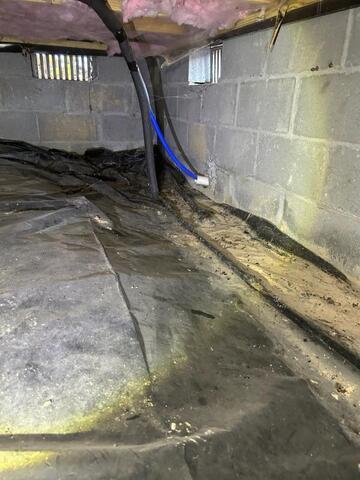
For a long time, vented crawl spaces were considered the standard. The idea was that outside air would move through the space, dry it out, and prevent moisture from building up.
If you’ve had moisture issues under your home, it makes sense that a fan feels like the next step. It seems like an upgrade to ventilation. More airflow should help dry things out.
That approach works in some climates, but not in the South.
In Tennessee, Alabama, and Kentucky, the outside air already holds a high amount of moisture. Instead of drying the space, you are constantly introducing humidity into it. The result is a crawl space that never fully dries out, no matter how much air is moving through it.
Why Fans Don’t Solve the Problem
Fans are designed to circulate air, not remove moisture from it
A fan only helps with humidity if it replaces moist air with dry air. In consistently humid climates, that exchange does not happen. The air being pulled in is already full of moisture.
That leaves you with two outcomes:
- You are moving humid air around the crawl space
- Or you are pulling in more humid air from outside
Either way, the moisture is still there.
This is why homeowners install fans and still deal with musty smells, mold growth, or damp conditions. The fan is not fixing the source of the problem.
How Outside Air Impacts Humidity
Relative humidity (RH) changes based on temperature, which is where crawl spaces run into issues.
Warm air can hold more moisture than cold air. When warm, humid air enters a cooler crawl space, its ability to hold that moisture drops. That excess moisture shows up as higher relative humidity.
In the summer:
Warm, humid air enters the crawl space, cools down, and the RH increases. This leads to moisture buildup
That environment can lead to:
- Mold growth
- Wood damage
- Pest activity
- Soft or sagging floors
In the winter:
Cold air enters the crawl space and warms up, which lowers the relative humidity overall. But the space is not dry.
The surfaces in the crawl space, like walls and pipes, are still cold. When warmer air comes into contact with those surfaces, condensation forms. Over time, that moisture builds up and creates the same issues.
Humidity problems do not go away in the winter. They just show up differently
To learn more about crawl space humidity, read "What Causes Humidity in a Crawl Space?"
What Actually Lowers Humidity in a Crawl Space
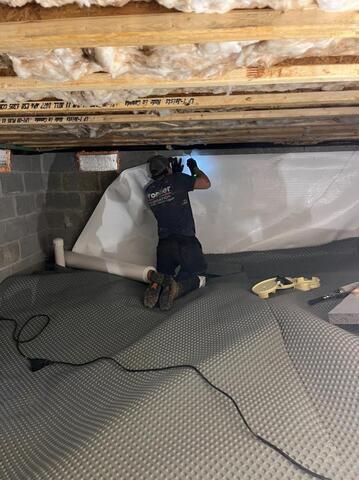
To lower the humidity, you need to stop moisture from entering the space and remove the moisture that is already there.
Encapsulation does the first part. Crawl space vents are closed and sealed. Drainage matting and a liner that covers the floor and walls of the crawl space are installed to prevent moisture from evaporating up from the ground and coming through the foundation walls.
From there, a dehumidifier handles the rest by pulling moisture out of the air and keeping humidity levels controlled.
At Frontier, we install the SaniDry Sedona Dehumidifier because it is built for crawl space conditions and can maintain consistent humidity levels year-round.
How to Keep Your Crawl Space Dry Long Term
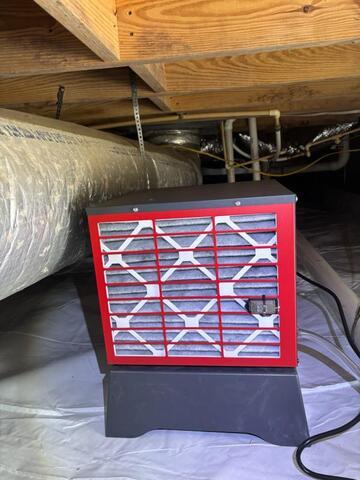
Keeping your crawl space dry is about control, not airflow.
The SaniDry Sedona Dehumidifier is designed to manage humidity without constant attention.
- Removes 2.9 liters per kilowatt hour
- Built-in humidity sensor for automatic control
- No trays or buckets to empty
- MERV 8 filter helps capture mold spores, dust, and other particles
- Digital controls for easy monitoring
- Can be ducted to help reduce noise
When it is paired with encapsulation, the crawl space becomes a controlled environment instead of one that is constantly reacting to outside conditions.
If you are relying on a fan to solve the humidity issue, the issue is likely still there. The air may be moving, but the moisture is not going anywhere.
Summary
Using a fan in your crawl space might feel like a step in the right direction, but it does not address the actual problem. In humid climates, fans often bring in more moisture or circulate the moisture that is already there.
Humidity in a crawl space is driven by outside air, temperature changes, and moisture from the ground. Without stopping those sources and removing moisture from the air, the problem will continue.
Encapsulation paired with a dehumidifier creates a controlled environment under your home. Instead of reacting to seasonal changes, your crawl space stays dry and stable year round.
FAQ
Do crawl space fans actually work?
Crawl space fans can help in dry climates where outside air has low moisture. In humid areas like Tennessee, Alabama, and Kentucky, they are usually ineffective because they bring in moist air instead of removing it.
Can a fan make crawl space humidity worse?
Yes. If the outside air is humid, a fan can pull that moisture into the crawl space or circulate the moisture that is already there, increasing overall humidity levels.
What happens if I run a fan with the vents closed?
The fan will mostly move the same humid air around the crawl space. Without a way to remove moisture, humidity levels will stay the same or continue to build.
What is the best way to lower crawl space humidity?
The most effective solution is to fully encapsulate the crawl space and install a dehumidifier. This stops moisture from entering and removes moisture from the air to keep levels controlled long term.